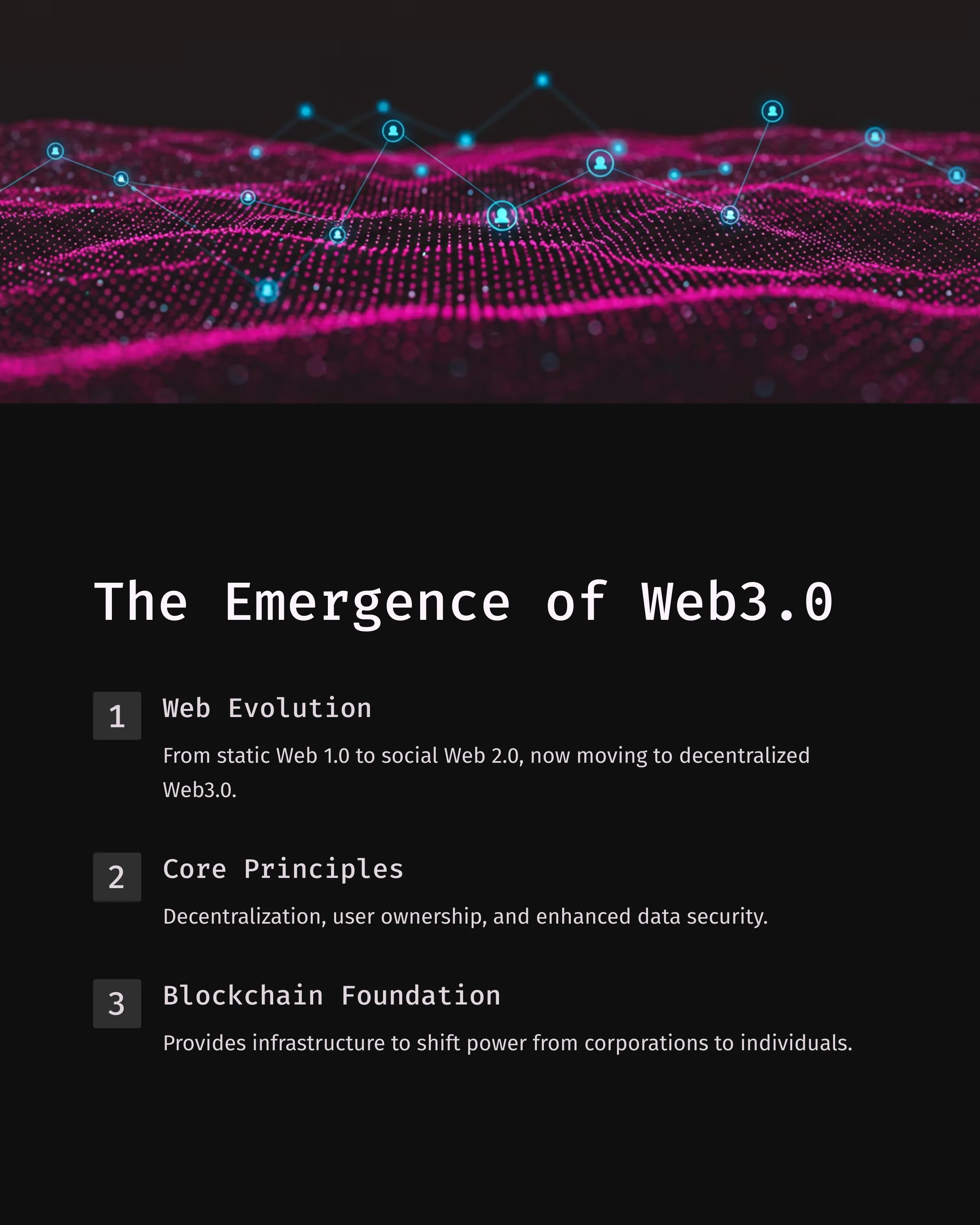
The internet has undergone a significant evolution since its inception. Web 1.0, the initial phase, was characterized by static websites and limited user interaction. The advent of Web 2.0 brought about dynamic content, social media platforms, and user-generated content, albeit largely controlled by centralized corporations. Now, a new paradigm is emerging: Web3.0, envisioned as the next iteration of the internet, built upon the principles of decentralization, user ownership, and enhanced data security . This evolution promises to reshape how individuals interact with the digital world, shifting power away from centralized entities and towards individual users. At the heart of this transformation lies blockchain technology, providing the foundational infrastructure necessary to realize the core tenets of Web3.0 . This report aims to explore the meaning and inherent value of Web3.0, analyze the critical role of blockchain technology in its development, and identify cryptocurrencies anticipated to be significantly influenced by this evolving landscape, with a particular focus on Dogecoin as a compelling case study.
Understanding the Fundamentals: Defining Web3.0 and its Core Characteristics
Web3.0 represents a fundamental shift in the architecture and operation of the internet. It is often described as the third generation of the World Wide Web, moving beyond the centralized models of Web 2.0 to embrace decentralization and user empowerment . This new era aims to create a more democratic and secure web, reducing reliance on centralized authorities and intermediaries that currently control vast amounts of user data . Web3.0 is not solely defined by a single technology but rather encompasses a suite of advancements, with blockchain being a cornerstone .
Several core characteristics distinguish Web3.0 from its predecessors. Decentralization is perhaps the most defining feature, referring to the distribution of data and control across a network of computers rather than being held by a single entity . This distributed nature enhances security by eliminating single points of failure, making the network more resilient to attacks and outages. Furthermore, it empowers users with greater control over their data, as it is no longer exclusively stored and managed by large corporations. Trustlessness and Permissionless systems are another key aspect, allowing users to interact and transact directly with each other without the need for trusted third parties or requiring permission from a central authority . This is often facilitated by smart contracts and blockchain’s immutable ledger, which ensure that transactions can be executed securely and transparently without relying on intermediaries.
The concept of the Semantic Web is also central to Web3.0, envisioning a web where data is not just presented but also understood by machines . This enables more intelligent applications capable of processing and interpreting information in a way that is closer to human understanding, leading to more relevant search results and personalized user experiences. Interoperability is another crucial aim of Web3.0, focusing on creating seamless connections between diverse technologies and platforms . This data portability and cross-platform functionality would allow users to switch between services while maintaining their preferences and settings, enhancing convenience and flexibility. The goal of Ubiquity and Connectivity underscores the vision of an internet that is accessible from anywhere, through any platform, on any device, further expanding its reach and inclusivity .
Artificial Intelligence (AI) and Machine Learning (ML) are also integral to the Web3.0 landscape . These technologies enable computers to understand the context of user requests and provide more personalized and intuitive experiences. AI and ML algorithms can process and analyze vast amounts of data, leading to more sophisticated applications and services. Finally, User Sovereignty and Data Ownership represent a fundamental shift in the power dynamic of the internet . Web3.0 aims to give users control over their own data, allowing them to decide who has access to it and potentially even monetize it, contrasting with the data harvesting practices prevalent in Web 2.0.
Unveiling the Potential: Analyzing the Value and Benefits of Web3.0 Across Various Dimensions
The emergence of Web3.0 holds significant potential value across numerous dimensions, promising a more user-centric, secure, and equitable internet .
Enhanced User Control and Data Ownership stand as a primary value proposition . In contrast to Web 2.0 where user-generated data is often controlled and monetized by tech giants, Web3.0 aims to return control to individuals. Users will have the ability to decide what information they share and with whom, potentially even earning revenue from their own data . This shift directly addresses growing privacy concerns associated with centralized platforms.
Web3.0 also promises Increased Transparency and Security . The decentralized and immutable nature of blockchain technology provides a foundation for more transparent transactions and data management. All stakeholders can potentially have visibility into the value and commerce they are associated with, without relying on a central intermediary for access to this data . The inherent cryptographic security of blockchain also aims to reduce the risk of fraud and cyberattacks .
A key benefit of Web3.0 is the potential for Reduced Reliance on Intermediaries . By connecting companies directly with customers through blockchain-based systems, Web3.0 can minimize or eliminate the need for central authorities that often take a share of earnings from electronic transactions. This disintermediation can lead to lower costs and increased efficiency in various online interactions.
The rise of New Economic Models and Tokenized Economies is another significant aspect of Web3.0’s value . Cryptocurrencies and Non-Fungible Tokens (NFTs) are integral to this new paradigm, enabling novel forms of value exchange and incentives. Tokenization allows for the representation of both digital and physical assets on the blockchain, potentially revolutionizing ownership and monetization. For instance, NFTs provide a mechanism for creators to monetize their digital work directly, while cryptocurrencies facilitate decentralized transactions and can incentivize user participation in online communities.
Web3.0 also aims to deliver an Improved User Experience . The integration of AI and semantic web technologies promises more personalized content, smarter search functionalities, and seamless interoperability between different platforms and devices. Websites and applications will be better able to recognize user preferences, leading to a more tailored and efficient online experience .
Finally, Web3.0 strives for Democratized Access and Reduced Censorship . By building on open and permissionless systems, Web3.0 aims to foster greater inclusivity and limit the control exerted by central authorities. Decentralized applications (dApps) built on blockchain, for example, are designed to be resistant to censorship and restrictions, offering users more freedom in accessing and sharing information online.
The Foundational Layer: How Blockchain Technology Powers the Development of Web3.0
Blockchain technology serves as the bedrock upon which the decentralized vision of Web3.0 is being constructed . Its unique properties directly address the core requirements of a decentralized, transparent, and secure internet.
Blockchain’s inherent Decentralization is fundamental to Web3.0 . Unlike traditional centralized databases, blockchain distributes data and control across a network of participants, eliminating any single point of control or failure. This distributed ledger technology ensures that information is not owned by a single entity, fundamentally altering the power dynamics of the internet.
Transparency and Immutability are other key characteristics of blockchain that are crucial for Web3.0 . Every transaction or piece of data recorded on a blockchain is added to a public ledger that is virtually unchangeable. This fosters trust among users as all activities are visible and verifiable, reducing the potential for fraud and manipulation.
Blockchain provides robust Security through its cryptographic techniques . Data is protected from unauthorized access and tampering through advanced encryption methods, building a more secure online environment for users and their digital assets.
The technology also enables Digital Ownership in Web3.0 . Blockchain facilitates the creation and management of unique digital assets, such as cryptocurrencies and NFTs, by providing a secure and transparent record of ownership and transferability. This is essential for building new digital economies and managing digital identities.
Smart Contracts, self-executing contracts with the terms directly written into code on the blockchain, are another vital component . They automate agreements and transactions without the need for intermediaries, increasing efficiency and reducing the risk of human error.
Finally, blockchain enables the development of Decentralized Applications (dApps) . These applications run on decentralized networks rather than centralized servers, offering users more control over their data and interactions as they are not subject to the control of a single entity.
Illustrative examples of blockchain’s role in Web3.0 abound. Uniswap is a decentralized exchange that allows users to trade cryptocurrencies without intermediaries, relying entirely on smart contracts for its operation . Aave is a decentralized lending and borrowing protocol that uses blockchain to connect lenders and borrowers directly . Decentraland and The Sandbox are metaverse platforms where ownership of virtual land and in-world assets is represented by NFTs on the blockchain . Filecoin offers a decentralized cloud storage solution, utilizing blockchain to create a marketplace for storage providers and users . Chainlink provides decentralized oracle services, using its blockchain-based network to securely connect smart contracts with real-world data . These examples demonstrate how blockchain technology is not just a theoretical foundation but a practical enabler of the diverse applications and services that constitute the burgeoning Web3.0 ecosystem.
Identifying Key Players: Cryptocurrencies Positioned for Growth in the Web3.0 Ecosystem
Cryptocurrencies are the native digital assets of the Web3.0 ecosystem, playing a crucial role in facilitating transactions, governing decentralized networks, and incentivizing participation . Several cryptocurrencies, by virtue of their underlying technology and focus, are particularly well-positioned to benefit from and contribute to the growth of Web3.0.
Ethereum (ETH) stands as a foundational blockchain for smart contracts and decentralized applications, hosting a vast majority of dApps and NFTs, making it critical infrastructure for Web3.0 . Its current market capitalization reflects its significant role in the ecosystem. Polkadot (DOT) focuses on blockchain interoperability, aiming to connect different Web3.0 projects and facilitate seamless communication and value exchange between them . Cardano (ADA) is another platform for smart contracts and decentralized applications, emphasizing scalability and sustainability as key features for the next generation of the web . Solana (SOL) is known for its high transaction speed and lower fees, making it a suitable platform for various Web3.0 applications requiring fast and cost-effective operations . Chainlink (LINK) provides decentralized oracle services, connecting blockchains with real-world data that is essential for many Web3.0 applications to function correctly .
In the realm of decentralized finance, Uniswap (UNI) is a leading decentralized exchange that facilitates the trading of Web3.0 assets without intermediaries , while Aave (AAVE) is a prominent decentralized lending and borrowing protocol, transforming traditional financial services . The metaverse is represented by cryptocurrencies like Decentraland (MANA) and The Sandbox (SAND), which power virtual land ownership and in-world transactions within these emerging digital worlds . Filecoin (FIL) provides decentralized storage solutions, a crucial component for managing the increasing data demands of Web3.0 , and Theta Network (THETA) focuses on decentralized video streaming, aiming to disrupt the traditional content delivery model . Helium (HNT) is building a decentralized wireless network, contributing to the infrastructure layer of Web3.0 . Cosmos (ATOM), similar to Polkadot, is focused on enabling interoperability between different blockchains within the Web3.0 ecosystem . Maker (MKR) governs the MakerDAO and the DAI stablecoin, which is vital for stability within the decentralized finance sector , and Compound (COMP) is another key player in the decentralized lending space . Privacy-focused cryptocurrencies like Zcash (ZEC) and Monero (XMR) are also relevant as Web3.0 emphasizes user privacy and data protection . Finally, Layer-2 scaling solutions for Ethereum, such as Optimism (OP) and Arbitrum (ARB), are crucial for improving the usability and scalability of the Web3.0 ecosystem built on Ethereum .
Exploring the Dynamics: Scenarios of How Web3.0 Advancement Can Influence Specific Cryptocurrency Values
The advancement and adoption of Web3.0 technologies have the potential to significantly influence the value of various cryptocurrencies. Increased usage of decentralized applications could drive demand for the native tokens of platforms like Ethereum, Cardano, and Solana . As more users interact with dApps, the need for the underlying blockchain resources, paid for with these tokens, would likely increase. Similarly, the growth of Decentralized Finance (DeFi) could positively impact the value of tokens associated with leading DeFi platforms such as Uniswap and Aave . Increased total value locked (TVL) and platform usage would likely translate to greater demand for these governance and utility tokens.
The expansion of the metaverse, a key use case for Web3.0, could lead to higher demand for the native tokens of platforms like Decentraland and The Sandbox . These tokens are essential for transactions within these virtual worlds, including the purchase of virtual land and other digital assets. The increasing need for different blockchains to communicate and exchange value seamlessly within Web3.0 could also drive demand for interoperability solutions like Polkadot and Cosmos . Their tokens facilitate network governance and the transfer of assets across different blockchain ecosystems.
The functionality of Web3.0 applications often relies on access to real-world data, which is provided by oracle services like Chainlink . As the Web3.0 ecosystem matures, the demand for reliable and decentralized oracle services is expected to grow, potentially benefiting the value of LINK tokens. Similarly, the need for decentralized storage solutions offered by projects like Filecoin and decentralized wireless networks like Helium could increase demand for their respective tokens as data management and connectivity become more distributed in Web3.0 . Furthermore, as Ethereum remains a primary platform for Web3.0 development, the success and adoption of Layer-2 scaling solutions like Optimism and Arbitrum, which aim to improve transaction speed and reduce costs, could positively influence the value of their native tokens .
The Horizon Ahead: Additional Cryptocurrencies to Watch in the Evolving Web3.0 Market
Beyond the cryptocurrencies already discussed, several other projects are emerging within the Web3.0 landscape that warrant attention. Projects focusing on decentralized identity solutions aim to give users greater control over their digital identities, which is a core tenet of Web3.0. Cryptocurrencies powering decentralized data storage solutions, beyond Filecoin, are also crucial for building a distributed web. Furthermore, new metaverse projects and related tokens continue to emerge, each offering unique virtual experiences and economic models. As the Web3.0 ecosystem evolves, it is important to monitor these and other innovative projects that are pushing the boundaries of decentralization and user empowerment.
Comprehensive Snapshot: Cryptocurrency Overview Table
The following table provides an overview of key cryptocurrencies relevant to the Web3.0 ecosystem, including their market capitalization (as of March 25, 2025, using data from various sources), primary technical features, and relevance to Web3.0.
| Cryptocurrency Name (Ticker) | Current Market Cap (USD) | Primary Technical Features | Relevance to Web3.0 |
| Ethereum (ETH) | ~$249.45 Billion | Proof-of-Stake, Smart Contracts, dApp Platform | Foundational platform for dApps and NFTs |
| Polkadot (DOT) | ~$7.43 Billion | Proof-of-Stake, Interoperability, Parachains | Interoperability layer connecting different blockchains |
| Cardano (ADA) | ~$27.16 Billion | Proof-of-Stake, Smart Contracts, Scalability Focus | Platform for dApps with emphasis on scalability |
| Solana (SOL) | ~$73.81 Billion | Proof-of-History, High Transaction Speed, Low Fees | High-performance platform for various Web3.0 applications |
| Chainlink (LINK) | ~$10.41 Billion | Decentralized Oracle Network, Connecting Off-Chain Data | Provides real-world data to blockchains |
| Uniswap (UNI) | ~$4.47 Billion | Decentralized Exchange, Automated Market Maker (AMM) | Facilitates trading of Web3.0 assets |
| Aave (AAVE) | ~$2.86 Billion | Decentralized Lending and Borrowing Protocol | Enables decentralized financial services |
| Decentraland (MANA) | ~$0.62 Billion | Metaverse Platform, Virtual Land Ownership (NFTs) | Powers virtual experiences and digital asset ownership |
| The Sandbox (SAND) | ~$0.70 Billion | Metaverse Platform, User-Generated Content, NFTs | Enables virtual world creation and NFT trading |
| Filecoin (FIL) | ~$2.02 Billion | Decentralized Storage Network, IPFS Integration | Provides decentralized data storage solutions |
| Theta Network (THETA) | ~$0.98 Billion | Decentralized Video Streaming, Edge Computing | Focuses on decentralizing video delivery |
| Helium (HNT) | ~$0.60 Billion | Decentralized Wireless Network, Proof-of-Coverage | Builds a distributed wireless infrastructure |
| Cosmos (ATOM) | ~$1.88 Billion | Interoperability, IBC Protocol, Hub and Zone Architecture | Connects different blockchains in the Web3.0 ecosystem |
| Maker (MKR) | ~$1.08 Billion | Governance Token for MakerDAO, Backs DAI Stablecoin | Crucial for the stability of DeFi |
| Compound (COMP) | ~$0.40 Billion | Decentralized Lending Protocol, Interest Rate Algorithms | Another key platform for decentralized lending |
| Zcash (ZEC) | ~$0.51 Billion | Privacy-Focused Cryptocurrency, zk-SNARKs | Offers enhanced transaction privacy |
| Monero (XMR) | ~$4.14 Billion | Privacy-Focused Cryptocurrency, Ring Signatures, Stealth Addresses | Provides strong transaction privacy |
| Optimism (OP) | ~$1.50 Billion | Ethereum Layer-2 Scaling Solution, Optimistic Rollups | Improves Ethereum’s scalability and reduces transaction costs |
| Arbitrum (ARB) | ~$1.81 Billion | Ethereum Layer-2 Scaling Solution, Optimistic Rollups | Enhances Ethereum’s scalability and lowers fees |
| Dogecoin (DOGE) | ~$30.24 Billion | Scrypt Proof-of-Work, Inflationary Supply, Community-Driven | Potential payment currency, tipping within decentralized platforms |
Navigating the Landscape: Understanding the Risks Associated with Investing in Web3.0-Related Cryptocurrencies
Investing in Web3.0-related cryptocurrencies, while potentially rewarding, carries significant risks that investors must carefully consider . The cryptocurrency market is inherently characterized by Market Volatility , with prices subject to rapid and substantial fluctuations, potentially leading to significant losses for investors. The Web3.0 space is also subject to Technological Risks . The field is rapidly evolving, and new technological advancements could render existing projects and technologies obsolete. Security vulnerabilities in blockchain protocols and smart contracts also pose a continuous threat.
Regulatory Uncertainty represents another significant risk . The regulatory landscape for cryptocurrencies and Web3.0 is still developing, and potential unfavorable regulations or government actions could negatively impact the market and the value of these assets. The Adoption Challenges faced by Web3.0 technologies and cryptocurrencies are also a crucial consideration . Widespread adoption is not guaranteed and depends on various factors, including user-friendliness, scalability, and real-world utility. The cryptocurrency market is also highly competitive, with new projects constantly emerging, leading to Competition Risks . New projects with superior technology or innovative use cases could potentially displace existing ones.
Despite the promise of decentralization, some Web3.0 projects and cryptocurrencies may still exhibit Centralization Risks within Decentralization . Control might still be concentrated among a small group of developers or large stakeholders, which could pose risks to the network’s true decentralization. For meme coins like Dogecoin, there are specific Meme Coin Speculation Risks . Their value is often driven by social media sentiment and hype, making them particularly susceptible to volatile price swings and pump-and-dump schemes.
Conclusion: Charting the Future of Web3.0 and its Implications for Cryptocurrency Investments
Web3.0 represents a compelling vision for the future of the internet, characterized by decentralization, user ownership, and enhanced security, with blockchain technology serving as its fundamental building block. The potential benefits of this new era are vast, promising greater user control, transparency, and the emergence of novel economic models. The role of blockchain in enabling these features is undeniable, providing the necessary infrastructure for a more distributed and trustworthy online environment.
The cryptocurrency landscape is intricately linked with the development of Web3.0, with numerous digital assets poised to play significant roles in its growth. Platforms enabling smart contracts and decentralized applications, interoperability solutions, DeFi protocols, metaverse tokens, and infrastructure providers are all likely to be influenced by the trajectory of Web3.0.
However, investing in Web3.0-related cryptocurrencies is not without considerable risks. Market volatility, technological uncertainties, regulatory developments, adoption challenges, and intense competition all present potential headwinds. For meme coins like Dogecoin, the risks associated with speculative trading and market sentiment are particularly pronounced. As such, while the opportunities within the Web3.0 cryptocurrency market are significant, investors must approach this space with caution, conducting thorough research and exercising due diligence to navigate the inherent risks effectively. The future of Web3.0 and its impact on cryptocurrency investments will undoubtedly be shaped by continued technological innovation, evolving regulatory frameworks, and the pace of mainstream adoption.
#Web3 #BlockchainTechnology #Decentralization #CryptoInnovation #SmartContracts
#DeFi #NFTs #Metaverse #DigitalOwnership #Dogecoin
#Ethereum #CryptoInvesting #CryptoTrends #Layer2 #AIinWeb3
#DataSovereignty #PrivacyCoins #TokenEconomy #Interoperability #FutureOfInternet
Author

Related Posts

Ripple’s Federal Reserve ‘Master Account’ Application: An Analysis of its Concept, Context, and Impact
1. Introduction and Research Purpose Ripple, a leading American cryptocurrency firm, has recently become a hot topic by taking the unusual step...

Analysis Report on Elon Musk’s Resignation from the Department of Government Efficiency (DOGE) and Its Impact on the Dogecoin Market
1. Introduction This report provides a comprehensive analysis of Elon Musk’s announced resignation from his role at the Department of Government Efficiency...
Read out all
Decoding the Executive Order: Modernizing America’s Federal Payments
Executive Summary This executive order, announced on March 25, 2025, mandates the conversion of all federal government expenditures and revenues from paper-based...
Read out all
Ripple and Amex Partnership: Verifying the Facts and Exploring the Impact on XRP and Global Finance
This report verifies the authenticity of the recent partnership news between Ripple and American Express (Amex), analyzes its impact on the financial...
Read out all
In-Depth Analysis Report on Pi Network: Scam Coin or Future Basic Income?
1. Introduction The cryptocurrency market has undergone rapid growth in recent years, bringing significant changes to the financial landscape. Amidst this evolution,...
Read out all
In-Depth Research Report: Expansion and Fragmentation of Stablecoins — Structural Risks and Strategic Scenarios
As the global digital finance ecosystem evolves, stablecoins are emerging not only as a promising digital asset class but also as a...
Read out all